Modular Smart Villas – Innovation, Comfort, and Value
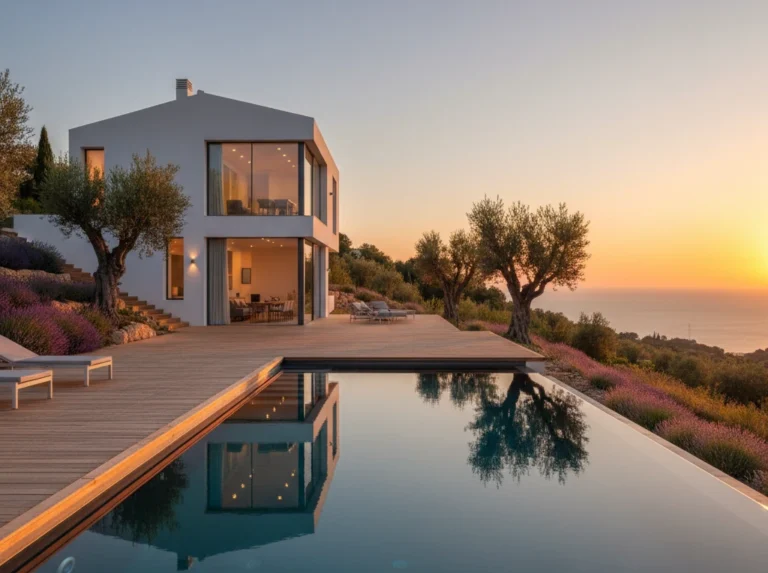
The real estate market is evolving, and modular smart villas have emerged as a game-changing trend on the Spanish coast. These cutting-edge homes can be built 2–3 times faster than traditional villas, come equipped with the latest “smart home” technologies, and cost significantly less compared to classic construction. In this overview, we will explore the key advantages of modular villas and compare them with conventional homes. You’ll see why more and more investors, expats, and forward-thinking homebuyers are choosing modular smart villas in the Marbella–Malaga region – to combine luxury and comfort with economic benefits.
Construction Speed and Efficiency
Time is money, especially when building your dream home. A traditional brick-and-concrete villa typically takes 12–24 months or more to complete, often delayed by weather, contractor schedules, and bureaucracy. Modular construction radically accelerates the timeline: 80–90% of the house is manufactured in a factory while the site foundation is prepared in parallel. Once modules are ready, they are transported and assembled on-site in a matter of weeks. The result is a turnkey smart villa that can be ready in as little as 4–6 months from project start. Developers back this up – for example, the NeoVilla project by Tekce delivers homes in 4–6 months, compared to 1–1.5 years using traditional methods. For the buyer, this means moving in sooner, saving money on temporary accommodations or rent, and starting to earn rental income faster if it’s an investment property. Factory fabrication also reduces errors and rework – a coordinated team builds your home indoors unaffected by weather. Simply put, modular villas have no equal in construction speed: you save up to 50–60% of the build time versus a conventional house.
Cost: More Affordable Than Traditional Homes
Cost is one of the most compelling arguments for modular villas. Conventional construction of a custom villa entails major expense: aside from materials and labor (averaging €1300–2000 per m²), there are architect fees, permits, project management, and unforeseen overages – budgets often blow out beyond initial estimates. On the Costa del Sol, finished villas also carry a premium due to high demand. Modular homes, in contrast, can be 20–30% cheaper on average. Efficient factory production and shorter build times mean lower labor and overhead costs. Experts estimate standard modular builds at around €800–1200/m², whereas a comparable traditional build easily runs €1300–1500/m² or more (especially with new energy regulations and pricy materials). The use of standardized modules allows for an accurate fixed price quote upfront, avoiding budget creep. In sum, you get a high-end villa for roughly half the price of a similar-size traditional villa (considering that buying an existing villa also includes developer profit and a “prestige markup”). Additionally, modular projects often offer flexible payment plans or assistance with investor “golden visa” documentation – adding to the financial appeal.
Technology: Smart Homes & Modern Living
A smart villa is a home that takes care of your comfort and security. Premium modular homes typically come with a suite of innovations: a smart home system to control climate, lighting, blinds, and appliances via an app; a state-of-the-art security setup with cameras, motion sensors, and remote monitoring; pre-installed high-speed internet (fiber-optic cabling) and integrated entertainment systems. These built-in tech features make living ultra-convenient: you can create automated routines (“Good Night” mode turns off lights and arms security), control your villa from anywhere in the world, and enjoy voice-controlled assistants. While traditional villas often require retrofitting to add such systems, here it’s all included from the start. Moreover, modular homes easily incorporate eco-friendly tech: rooftop solar panels, rainwater harvesting, home battery storage, even EV charging stations – all planned during design. Globally, about 38% of new modular homes already integrate smart features and green components, targeting millennial and Gen Z buyers. In other words, by choosing a modular smart villa, you’re getting a future-ready home built for the digital age and sustainable living.
Quality & Durability: New Building Standards
There is a myth that modular homes aren’t as sturdy as “brick and mortar” houses. In reality, modern modular construction meets or exceeds traditional building standards. Villa modules use high-grade steel frames or reinforced concrete designed for structural strength and seismic stability. Factory manufacturing ensures precise fitting and strict quality control at each step – a level of consistency hard to achieve on an open-air construction site. The modules are packed with modern insulation, proper waterproofing and soundproofing, and energy-efficient windows. As a result, a modular villa is certified to the same regulations as any site-built home. The guaranteed lifespan of such a house is 50+ years, even in challenging climates. Also, modular structures don’t settle like masonry, so there’s no waiting for shrinkage – interior finishes can be completed immediately with no risk of wall cracks. The quality of plumbing, wiring, and HVAC is also top-notch: all systems are installed in a controlled factory setting, ensuring high precision. Therefore, as an owner of a modular villa, you enjoy a solid, reliable home that won’t need major repairs for decades. In fact, many premium modular projects comply with green building certifications (LEED, BREEAM), underscoring their high construction quality.
Energy Efficiency & Eco-Friendliness
Today’s luxury homes are not just about looks – they’re expected to be smart about energy as well. Modular smart villas are inherently designed to be energy-efficient: thick insulation in walls and roofs reduces heat loss in winter and keeps interiors cool in summer; efficient heating systems (heat pumps, underfloor heating) and ventilation with heat recovery are standard. As a result, energy usage is significantly lower than that of most older traditional villas. Studies indicate that integrating advanced efficiency measures can cut energy consumption by up to 50%. This translates into dramatically smaller electricity and gas bills for the homeowner. Moreover, these villas often come equipped with solar power systems, home batteries to store surplus solar energy, and LED lighting throughout. Their eco-friendliness extends to construction materials: manufacturers lean towards sustainable or recycled materials and aim to minimize waste. Steel frames are 100% recyclable; any timber elements are usually sourced from sustainable forests, etc. Because modules are produced with precision, there is far less waste compared to a conventional build (where excess materials often end up in a dumpster). The outcome is a lower carbon footprint for construction, and a home that’s gentler on the environment throughout its life. For owners, this means saving money (lower utility costs) and knowing you’ve invested in “green” technology.
Design Flexibility and Expansion
One might think a modular home is constrained by standard blocks, but in practice the design possibilities are almost limitless. Developers offer dozens of base villa models – from cozy bungalows to expansive two-story estates. By configuring modules, you can achieve a personalized layout: combine modules to create an open-plan living area with double-height ceilings, add panoramic glass walls, integrate terraces and infinity pools. Modern modular villas come in various architectural styles too: minimalist, high-tech contemporary, Mediterranean, or even Scandinavian barn-house aesthetic. Buyers typically get to choose interior finishes and fixtures to suit their taste. Furthermore, a modular home can “grow” with you: if you later need more space, you can purchase and attach an additional module (for instance, to add a new bedroom or enlarge the kitchen). A popular option is a guest house or studio module that can be added on the property. This adaptability is a major advantage over traditional houses – expanding or reconfiguring a conventional villa is much more complicated and costly. Thus, when you invest in a modular villa, you’re buying a home that can adapt to your evolving needs without major reconstruction.
Modular smart villas represent a fusion of technology, design, and value. They are built faster, cost less, and last as long as traditional homes – all while offering a level of comfort tailored to the 21st century. It’s no surprise experts predict modular housing will capture a significant share of the luxury real estate market in the coming years, and it’s already becoming mainstream in many countries.
If you’re considering a home in the Malaga or Marbella area, take a look at what Modulove offers. We specialize in constructing turnkey modular smart villas on the Costa del Sol. Our team handles the entire process – from design to construction to final handover – making your dream of a modern, eco-friendly, stylish home in Spain a reality. Contact us for a free consultation and to learn more about Modulove’s projects. Join the smart villa revolution and invest in the future – it’s here now!